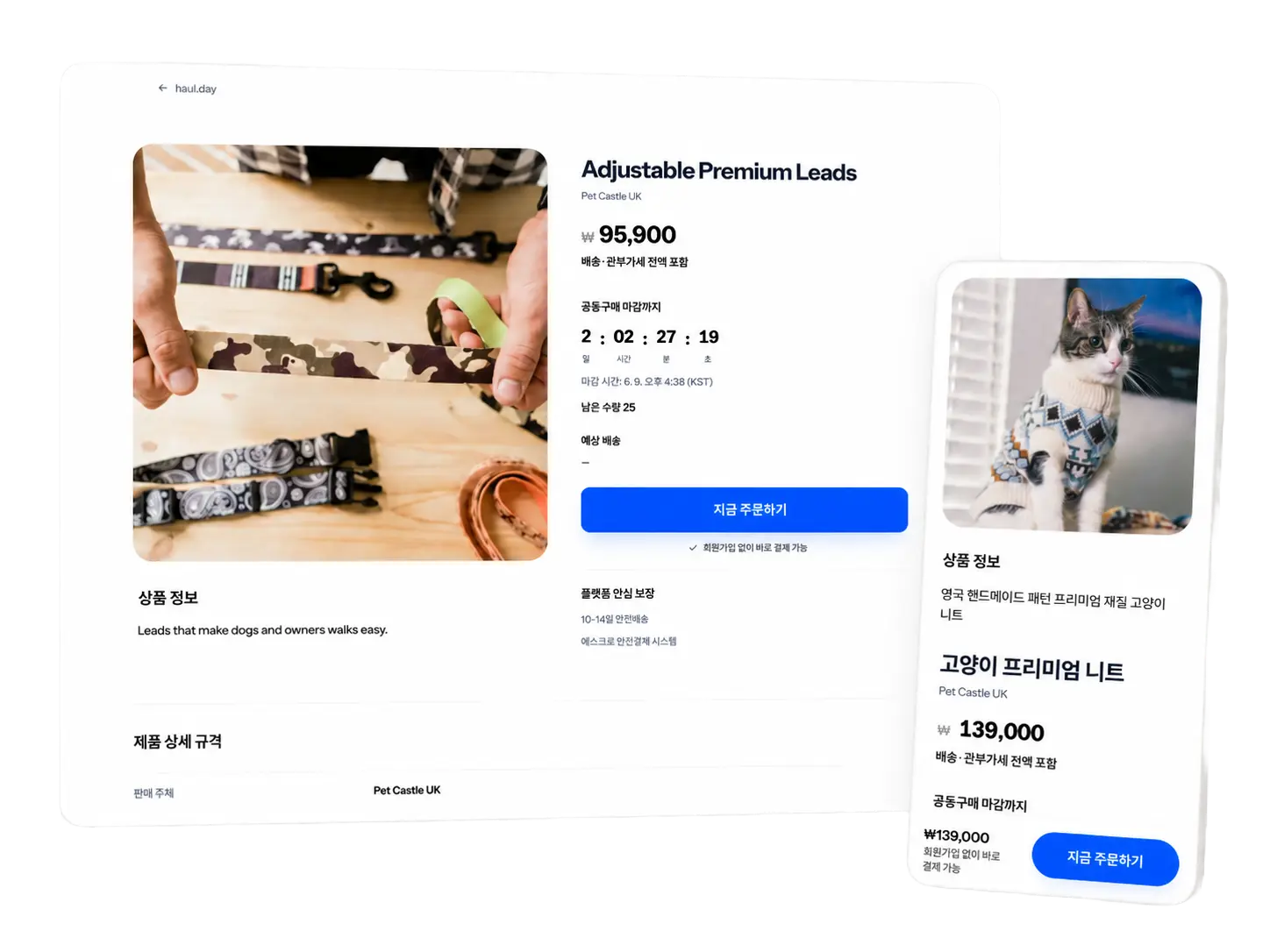
Launch where the market feels live, and the execution still feels fully under control.
Start with trusted Korea demand, keep your brand visible at purchase, and let haul.day handle the local flow end to end.
How the first launch actually works.
Four simple steps. No long explanation needed.
Trusted partner opens demand
A trusted community opens the first wave of Korea demand.
Your brand stays the seller
The order closes on your branded offer, not a reseller listing.
haul.day runs the local flow
Payment, delivery, and tracking are localized for the launch.
A first launch becomes a signal
You learn from real demand before committing to a bigger build.
One launch, three clear roles.
Keep responsibilities explicit so the model stays easy to scan.
The trusted demand source
- Opens the first wave of Korea demand
- Provides recommendation context people already trust
- Creates a strong start without cold acquisition first
Brand ownership stays visible
- Brand identity and customer relationship
- Clear seller presence at purchase
- A measured first step before a full Korea buildout
The local commerce layer
- Localized payment and checkout flow
- Cross-border shipping and order tracking
- Operational execution around the launch
Who this works for, and why it lands more credibly than a generic market-entry pitch.
This should answer two questions in one pass. Why does the model feel different, and is it actually the right fit for your brand?
Most market-entry pages blur into one pitch. This one should read like an operating model. A trusted partner opens the first demand, your brand stays visible at the point of purchase, and the first launch gives you signal before heavier expansion.
The best fit is usually obvious. Brands with recommendation power benefit most. Brands chasing instant broad distribution usually do not.
Brands people genuinely want to recommend
This works best for brands where trust, taste, and recommendation matter.
- Indie or design-led brands with a clear point of view
- Products where recommendation matters more than discounting
- Teams testing Korea before hiring or building locally
Brands looking for broad distribution from day one
This is not a generic expansion agency or a low-trust volume channel.
- Commodity catalogs without a strong recommendation angle
- Affiliate-style performance expectations
- Teams expecting a full Korea organization immediately
Trusted demand opens first
Start with partner-led demand people already trust, instead of forcing a cold Korea launch from day one.
Your brand stays visible at purchase
The transaction closes on a branded offer with local payment and delivery, not a generic reseller listing.
You learn before you overbuild
Use a first launch to read demand, response, and operational fit before committing to a larger Korea setup.
Tell us enough to judge fit.
The application should feel direct. We only need the basics to understand whether haul.day is the right Korea entry model for your brand.
- You are not being asked for a full market-entry plan.
- We are checking whether the launch model matches your product and brand.
- If it fits, the next conversation is about the first launch, not a long sales process.
Tell us about your brand.
We review fit manually and follow up when the model makes sense.
What the next step looks like after you apply.
- We review whether your category, product, and brand positioning fit the model.
- If there is a fit, we follow up to structure the first Korea launch together.
- Before launch, we align on the branded offer, operating scope, and partner context.
- After the launch, you receive demand, order, and response signals to guide the next step.
The launch should feel controlled, not improvised.
- No surprise discounting or off-brand messaging without alignment.
- Brand and product details are reviewed before the launch goes live.
- The purchase experience keeps your brand visible at checkout.
- Partner distribution is selective, not a broad low-trust volume channel.
The practical questions brands usually ask first.
Early-stage trust does not come from saying more. It comes from answering the real objections clearly.
Do we need a Korea entity before starting?
No. The model is designed for brands testing Korea demand before committing to a full local setup.
What kinds of brands fit best?
Brands with a clear point of view, strong recommendation potential, and products that benefit from trust rather than discount-led acquisition.
How much control does the brand keep?
The brand remains visible at purchase, and the launch structure is aligned before it goes live.
What do we get after the launch?
You receive a practical post-launch read so the next move is based on real market signal, not guesswork.